10 Best Jeep Wrangler Lift Kits For On‑ and Off‑Road (Plus Buying Guide)

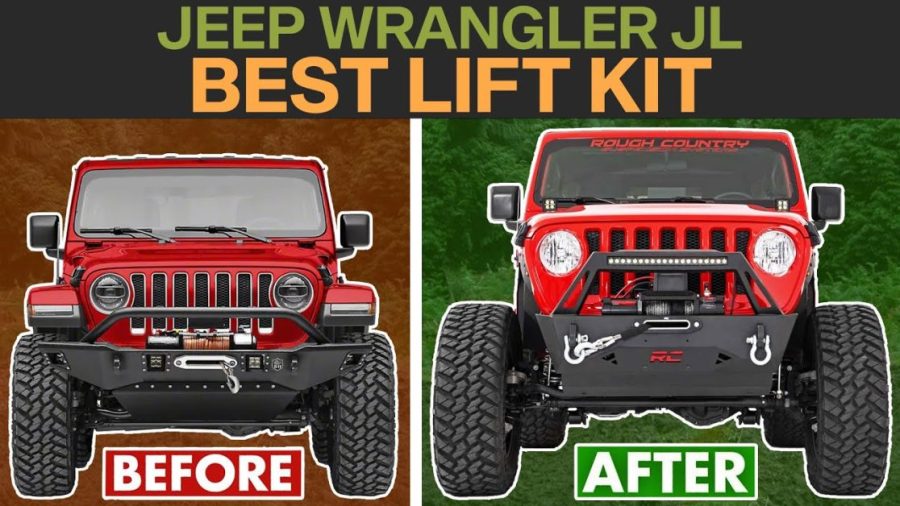
Upgrading your Jeep Wrangler with a lift kit changes how it looks, drives, and performs off-road. The right kit lets you clear bigger tires, improve approach angles, and keep daily driving manners under control. The wrong one can ruin ride quality, eat components, and burn your budget on fixes.
This guide breaks down the best Jeep Wrangler lift kits by use case, budget, and model, then walks through how to choose the ideal setup for your rig.
| Preview | Product | |
|---|---|---|
|
Mopar Genuine 2″ Lift Kit | Check Price |

|
Skyjacker C140CK Lift Components – Skyjacker 4WD Suspension Lift Kits Suspension Lift – 4WD… | Check Price |
How To Choose The Best Jeep Wrangler Lift Kit
Before picking a brand, you need clear goals. A mild weekend trail Jeep with 33s needs a different kit than a rock‑crawler on 37s.
Key factors to decide first:
- Driving mix: daily commuting, overlanding, rock crawling, or mostly street.
- Lift height: 1–2 inches, 2–3.5 inches, or 4+ inches.
- Tire size target: 33s, 35s, 37s, or more.
- Budget: just the kit, or kit plus all needed supporting mods.
Lift types: body, spacer, and full suspension
Each type lifts your Wrangler differently and comes with trade‑offs.
- Body lift kits: Use spacers between the body and frame.
- Pros: low cost, keeps factory suspension geometry, good for looks, and mild tire clearance.
- Cons: no extra ground clearance under the frame, limited off‑road gain, can look odd if too tall.
- Spacer (budget boost) kits: Use coil spacers on top of factory springs.
- Pros: affordable, simple, retains factory coils, quick install.
- Cons: limited travel gains, shocks often become a limiting factor, not ideal for heavy accessories.
- Full suspension lift kits: Replace springs and usually shocks, plus geometry parts.
- Pros: better articulation, real ground clearance, can handle heavy bumpers and gear.
- Cons: higher cost, longer install, often needs alignment parts.
How much lift for your Wrangler tires?
Exact numbers vary by generation and wheel offset, but this rule of thumb works well:
- Up to 33‑inch tires: stock height or 1–2 inch lift.
- 35‑inch tires: 2–3.5 inch suspension lift plus correct bump stops.
- 37‑inch tires: 3.5–4.5 inch lift, re‑gearing recommended, stronger steering parts.
- 40‑inch tires: hardcore builds only; axles, steering, brakes, and gears all need upgrades.
If you plan to run aggressive off‑road trails, aim for a bit more clearance than the bare minimum to avoid rubbing during full articulation.
Budgeting for the full cost of a lift
The sticker price of the kit is only part of the bill. As lift height climbs, supporting parts become mandatory.
Common “hidden” costs include:
- Professional installation and alignment.
- New control arms or geometry correction brackets.
- Adjustable track bars to recenter axles.
- Longer brake lines or relocation brackets.
- Driveshaft upgrades on taller lifts.
- Re‑gearing for 37‑inch tires and beyond.
Plan your build as a package rather than adding parts one at a time. That approach saves money and protects drivability.
Best Jeep Wrangler Lift Kits For Daily Drivers
If your Jeep spends most of its time on pavement with occasional dirt roads or light trails, ride quality and stability come first. You want something that clears larger tires without creating a harsh or floaty feel.
Mopar 2‑inch Lift Kit (JL)

The Mopar 2‑inch lift is factory engineered for the JL, which gives it a strong advantage for daily-driven Wranglers.
Key highlights:
- Engineered by the same team that designed the Wrangler chassis.
- Includes coil springs tuned for added weight, such as winch bumpers.
- Comes with premium shocks matched to the coils.
- Keeps driving manners close to stock while improving stance and clearance.
This kit works well for owners who want to run 35‑inch tires while keeping a factory‑like feel. It is also ideal for newer Jeeps still under warranty because it aligns with manufacturer standards.
Mild spacer lifts for a budget‑friendly daily

credit: aev-conversions.com
For drivers on a tighter budget, a 1.5–2.5 inch spacer kit can be enough. These kits reuse stock springs and may include shock extensions or entry‑level shocks.
When comparing spacer kits, focus on:
- Material quality of spacers and hardware.
- Compatibility with both two‑door and four‑door models.
- Clear instructions and support from the manufacturer.
Spacer lifts are a strong choice if the goal is just to fit 33‑inch tires and remove factory rake without building a full trail rig.
Best Jeep Wrangler Lift Kits For Weekend Trail Use
Weekend trail drivers need more than looks. Articulation, ground clearance, and consistent damping become more important while keeping on‑road comfort acceptable.
Rough Country 2.5‑inch Suspension Lift (JL/JK)
credit: roughcountry.com
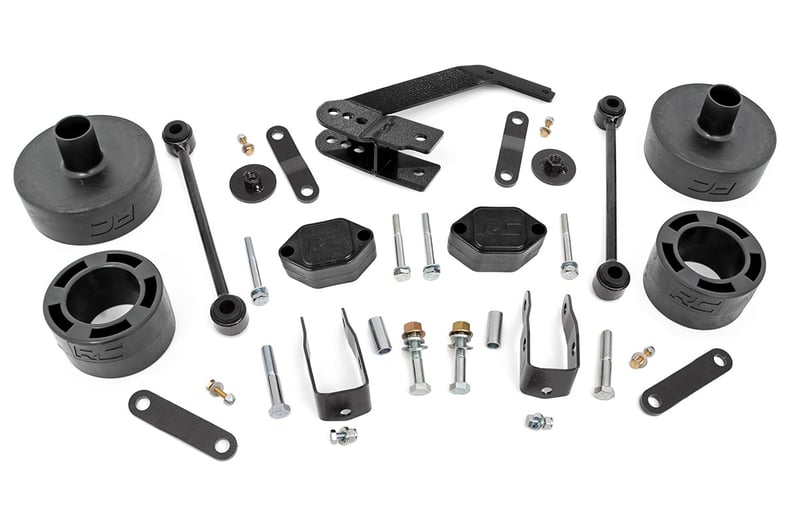
Rough Country offers a 2.5‑inch suspension lift with new coil springs and N3 shocks, rather than just spacers. This is a serious step up from a budget boost.
Key strengths:
- Front and rear coil springs with rates tuned for real trail use.
- N3 nitrogen‑charged shocks with multi‑stage valving for better control.
- Support for 35‑inch tires on most builds with correct bump stops.
- Good balance between cost and performance.
This kit suits Jeep owners who hit moderate trails regularly and want more control than stock without the price of premium long‑arm systems.
Skyjacker 3.5‑inch Lift Kit

Skyjacker’s 3.5‑inch kit fits drivers who want more height and articulation while still driving their Jeep to work.
Core features:
- Powder‑coated components to resist corrosion.
- Springs and shocks tuned for blended on‑road and off‑road performance.
- Hardware included for a clean install.
- Works for both two‑wheel and four‑wheel drive configurations.
If you plan to run 35s or even narrow 37s while keeping a comfortable ride, a mid‑height kit like this strikes a strong balance between capability and daily use.
Best Jeep Wrangler Lift Kits For Hardcore Off‑Road
Serious rock crawlers and overlanders push Wranglers far from pavement, often loaded with armor, camping gear, and recovery equipment. They need kits designed for abuse.
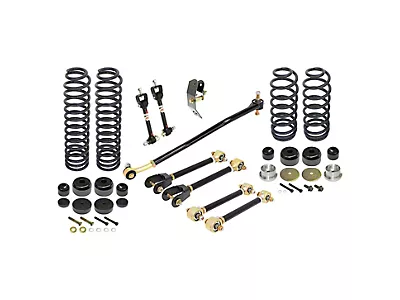
Metalcloak, EVO, and Rock Krawler systems
credit: www.extremeterrain.com
Among enthusiasts, brands like Metalcloak, EVO Manufacturing, and Rock Krawler are widely regarded as top‑tier choices for aggressive builds.
What sets these systems apart:
- True suspension systems, not just spring and shock packages.
- Heavy‑duty control arms with rebuildable or high‑end bushings.
- Tuned springs for ride height stability under heavy load.
- Components designed to maximize articulation without binding.
These kits shine on 37‑inch and larger tire builds where suspension geometry and durability matter more than cost. Many systems also include adjustable track bars, sway bar links, and bump stop solutions tailored to the platform.
Long‑arm and high‑end short‑arm kits
For lifts over 3.5 inches, long‑arm or advanced short‑arm systems help correct geometry. They maintain better ride quality and traction angles than simple tall spring kits.
When considering these:
- Confirm compatibility with your Wrangler generation and drivetrain.
- Check if welding is needed or if the kit is fully bolt‑on.
- Plan for driveshaft, steering, and gear upgrades in the same build cycle.
Hardcore setups demand careful planning, but the payoff is a Jeep that can crawl and climb obstacles that stock suspensions cannot touch.
Best Budget Lift Kits For Jeep Wrangler
Not every Wrangler owner wants to invest in a full-performance suspension right away. Budget‑friendly kits help you step into the lifted world without draining savings.
Body lift and leveling kits
Body lifts and leveling kits are the cheapest way to raise your Jeep’s stance.
Common scenarios where these shine:
- You want to run slightly larger tires but keep the stock suspension.
- You prefer the factory ride and only care about looks.
- You plan a bigger suspension build later and need a temporary solution.
Even with budget lifts, check for:
- High‑quality hardware and spacers.
- Clear documentation for torque specs and safety checks.
- Compatibility with bumpers, skid plates, and other accessories.
Entry‑level suspension kits
Some manufacturers offer bare‑bones kits that include springs and simple shocks at modest prices. These are good for drivers who want a better stance and mild trail capability.
Just remember:
- Cheap shocks tend to fade faster under repeated off‑road use.
- Springs without matched damping can feel floaty or harsh.
- You may outgrow the kit quickly if you start tackling harder trails.
If budget allows, choosing a kit with well‑matched springs and dampers pays off in comfort and control.
Best Lift Kits For Specific Jeep Generations
Lift needs and options differ between TJ, JK, JL, and Gladiator‑based Wranglers. Geometry, electronics, and driveline layouts all play a part.
TJ and older Wranglers
Short‑wheelbase TJs respond quickly to lift changes. Even a small height increase noticeably affects stability.
Key points for TJs:
- Modest 2–3 inch kits offer strong gains while staying manageable.
- Leaf spring YJs often use block or spring‑pack solutions instead of coils.
- Steering stabilizers, track bars, and control arms may need attention sooner.
Because of age, factor in bushing wear, rusted bolts, and old shocks when planning the install.
JK and JL Wranglers
JK and JL platforms, including Unlimited versions, provide more options and better factory geometry.
For JK and JL owners:
- 2–2.5 inch lifts with 35‑inch tires make excellent daily trail rigs.
- Taller builds benefit from upgraded control arms and track bars.
- Electronic aids such as stability control may require recalibration after big lifts.
The JL’s suspension and electronics support modern high‑end kits that deliver impressive comfort even at 3.5 inches or more of lift.
Installation, Alignment, And Maintenance Tips
A lift kit only works well if installed and maintained correctly. Small mistakes can cause poor tracking, uneven tire wear, and component damage.
DIY vs professional install
Many spacer and small suspension kits can be installed at home with jack stands, hand tools, and patience. However:
- Any kit above 2.5–3 inches benefits from a professional install.
- Long‑arm systems, welding, or driveshaft swaps are best left to experienced shops.
- A proper torque sequence and recheck after a few hundred miles are critical.
Plan for a professional alignment immediately after the lift. Revisit alignment after the suspension settles.
Ongoing checks after lifting
Lifted Wranglers need more frequent inspections than stock vehicles, especially when driven off-road.
Add these habits:
- Regularly check the control arm and track bar bolts for torque.
- Inspect shocks and springs for leaks, cracks, or sag.
- Listen for new noises after trails, such as clunks or popping.
- Watch tire wear patterns and adjust alignment if needed.
A few minutes of inspection after each off‑road trip can prevent major failures later.
Final Thoughts: Picking The Best Lift Kit For Your Wrangler
The best Jeep Wrangler lift kit is the one that fits your driving style, tire goals, and budget while keeping the vehicle safe and enjoyable. Subtle lifts with body or spacer kits work perfectly for daily drivers who want a cleaner stance and mild trail ability. Full suspension systems with quality springs, shocks, and geometry parts unlock serious off‑road performance.
Start by defining how you use your Jeep today and how you want to use it in two years. Match lift type and height to those plans, then choose a reputable brand with proven support. With a thoughtful approach, your lifted Wrangler will drive better, look tougher, and tackle trails with confidence.